

GenAge entry for FOXO1 (Homo sapiens)
Gene name (HAGRID: 124)
- HGNC symbol
- FOXO1
- Aliases
- FKH1; FKHR; FOXO1A
- Common name
- forkhead box O1
Potential relevance to the human ageing process
- Main reason for selection
- Entry selected based on evidence directly linking the gene product to ageing in a non-mammalian animal model
- Description
A transcription factor of the Fox family, FOXO1 is important in development [802]. It also appears to regulate apoptotic signals.
A homologue of FOXO1A, daf-16, has been associated with ageing in roundworms [628], and overexpression of another homologue, dFOXO, in adult fat body of fruit flies increased longevity in females [1238]. Mice overexpressing FOXO1 in skeletal muscle weighed less than controls and had a reduced skeletal muscle mass, suggesting that FOXO1 could play a role in the age-related decline in muscle mass [1467]. Results from mice also suggest that FOXO1 could be involved in type 2 diabetes [630]. Although at present there is no evidence directly linking FOXO1 to human ageing, it remains a putative player in the human ageing process.
Cytogenetic information
- Cytogenetic band
- 13q14.1
- Location
- 40,555,664 bp to 40,666,597 bp
- Orientation
- Minus strand
Protein information
- Gene Ontology
-
Process: GO:0000122; negative regulation of transcription from RNA polymerase II promoter
GO:0001568; blood vessel development
GO:0001659; temperature homeostasis
GO:0001678; cellular glucose homeostasis
GO:0006351; transcription, DNA-templated
GO:0006473; protein acetylation
GO:0006914; autophagy
GO:0006915; apoptotic process
GO:0006974; cellular response to DNA damage stimulus
GO:0008286; insulin receptor signaling pathway
GO:0009267; cellular response to starvation
And 28 more GO terms Cellular component: GO:0005634; nucleus
GO:0005654; nucleoplasm
GO:0005737; cytoplasm
GO:0005739; mitochondrion
GO:0005829; cytosol
Show all GO termsFunction: GO:0000981; RNA polymerase II transcription factor activity, sequence-specific DNA binding
GO:0000989; transcription factor activity, transcription factor binding
GO:0001078; transcriptional repressor activity, RNA polymerase II core promoter proximal region sequence-specific binding
GO:0001223; transcription coactivator binding
GO:0003682; chromatin binding
GO:0005515; protein binding
GO:0008013; beta-catenin binding
GO:0031625; ubiquitin protein ligase binding
GO:0043565; sequence-specific DNA binding
GO:0051721; protein phosphatase 2A binding
Protein interactions and network
- Protein-protein interacting partners in GenAge
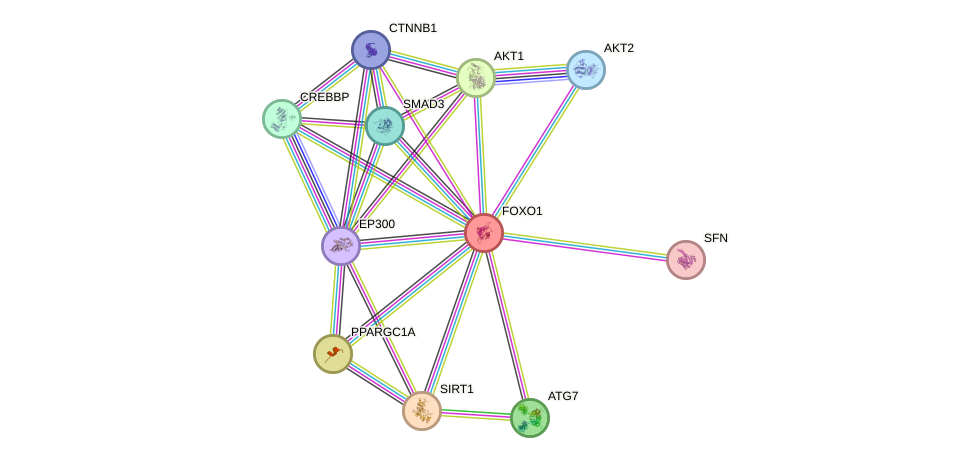
- AKT1, PARP1, CREBBP, CEBPB, EP300, PML, GSK3B, AR, RB1, FOXO1, SIRT1, YWHAZ, FOXO4, MDM2, ESR1, STUB1, CDKN1A
- STRING interaction network
Retrieve sequences for FOXO1
Homologs in model organisms
- Caenorhabditis elegans
- daf-16
- Danio rerio
- foxo1a
- Danio rerio
- foxo1b
- Drosophila melanogaster
- foxo
- Mus musculus
- Foxo1
- Rattus norvegicus
- Foxo1
- Saccharomyces cerevisiae
- HCM1
In other databases
- GenAge model organism genes
- GenDR gene manipulations
- LongevityMap
- This gene is present as FOXO1
- CellAge
- This gene is present as FOXO1
Selected references
External links
- EPD
- ORF Accession
- NM_002015
- CDS Accession
- NP_002006
- OMIM
- 136533
- HPRD
- 00645
- Ensembl
- FOXO1
- UniProt/Swiss-Prot
- FOXO1_HUMAN
- GeneCards
- FOXO1
- Entrez Gene
- 2308
- GenAtlas
- FOXO1
- Internet
- Search Google