GenAge Human Genes Help Human Ageing Genomic Resources Citation

GenAge entry for WRN (Homo sapiens)


Selected based on direct observations linking human ageing to WRN


Gene name (HAGRID: 0013)

HGNC symbolWRN
AliasesRECQL2; RECQ3
Common nameWerner syndrome, RecQ helicase-like

Potential relevance to the human ageing process

Main reason for selection

Entry selected based on evidence directly linking the gene product to ageing in humans

Description

Werner syndrome (WS), caused by mutations in WRN, is probably the most dramatic segmental progeroid syndrome. Although there are differences between the pathobiology of normal ageing and the phenotype of WS, the age-related changes of WS patients are remarkably similar to normal ageing, only they occur at earlier ages [0056].

WRN-deficient mice display reduced embryonic survival, increased tumour formation, and their fibroblasts show features similar to those found in fibroblasts derived from WS patients such as a premature loss of proliferative capacity, but their ageing process appears unaltered [0730]. Combining late-generation mice without TERC, and hence with short telomeres, with WRN mutations results in a phenotype resembling accelerated ageing somewhat reminiscent from WS [1069].

WRN is a helicase and exonuclease involved in many DNA repair and processing pathways [1265]. Its exact functions remain unknown, but it is one of the strongest candidates for genes influencing human ageing.

Cytogenetic information

Cytogenetic band8p12-p11.2
Location31,010,319 bp to 31,150,818 bp
OrientationPlus strand
Display region using the UCSC Genome Browser

Protein information

FunctionDNA repair, DNA condensation
Cellular locationnucleus
Expressionpre natal, mitotic cells, germ cells, stem cells, other
Gene Ontology

GO:0001302; replicative cell aging; Process
GO:0006139; nucleobase, nucleoside, nucleotide and nucleic acid metabolic process; Process
GO:0006310; DNA recombination; Process
GO:0040009; regulation of growth rate; Process

GO:0000166; nucleotide binding; Function
GO:0005524; ATP binding; Function
GO:0016787; hydrolase activity; Function

GO:0005622; intracellular; Cellular component
GO:0005634; nucleus; Cellular component

Protein-protein interactions

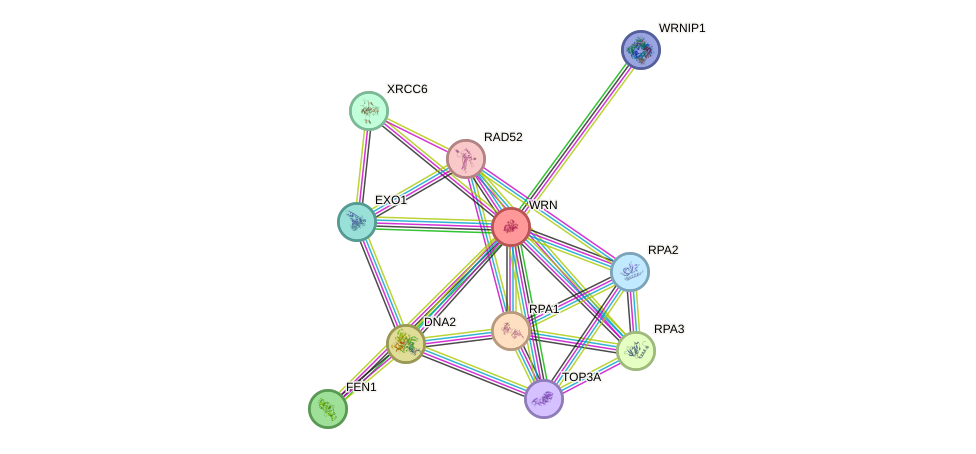
Interacting proteinsTP53, NBN, PARP1, BRCA1, BLM, VCP, TOP1, UBE2I, PRKDC, XRCC5, PCNA, FEN1, TERF2, XRCC6, POLD1, RAD52, SP1, SUMO1, H2AFX, POLB.
Display interactions using the IGD

Retrieve sequences for WRN

PromoterPromoter
ORFORF
CDSCDS

Homologues in model organisms

P. troglodytesWRN (Werner syndrome)
C. lupus familiarisWRN (Werner syndrome)
M. musculusWrn (Werner syndrome homolog (human))
G. gallusRCJMB04_27j8 (Werner syndrome)
D. rerioLOC569495 (similar to FFA-1 protein)
D. rerioLOC797071 (similar to FFA-1 protein)
A. gambiaeENSANGG00000012001 (ENSANGP00000014490)
C. eleganswrn-1 (human WRN (Werner's syndrome) related)
O. sativaOs07g0681600 (hypothetical protein)
HomoloGene (6659)

Selected references

[1896] Li et al. (2008), Regulation of WRN protein cellular localization and enzymatic activities by SIRT1-mediated deacetylation, PubMed
[1826] Eller et al. (2006), A role for WRN in telomere-based DNA damage responses, PubMed
[1794] Agrelo et al. (2006), Epigenetic inactivation of the premature aging Werner syndrome gene in human cancer, PubMed
[1825] Cheng et al. (2006), Collaboration of Werner syndrome protein and BRCA1 in cellular responses to DNA interstrand cross-links, PubMed
[1588] Harrigan et al. (2006), The Werner syndrome protein operates in base excision repair and cooperates with DNA polymerase beta, PubMed
[1585] Kuningas et al. (2006), Impact of genetic variations in the WRN gene on age related pathologies and mortality, PubMed
[1580] Davis et al. (2005), Prevention of accelerated cell aging in Werner syndrome using a p38 mitogen-activated protein kinase inhibitor, PubMed
[1572] Szekely et al. (2005), Werner protein protects nonproliferating cells from oxidative DNA damage, PubMed
[1519] Lan et al. (2005), Accumulation of Werner protein at DNA double-strand breaks in human cells, PubMed
[1511] Hirai et al. (2005), WRN gene 1367 Arg allele protects against development of type 2 diabetes mellitus, PubMed
[1510] Karmakar and Bohr (2005), Cellular dynamics and modulation of WRN protein is DNA damage specific, PubMed
[1509] Friedemann et al. (2005), Nuclear DNA helicase II (RNA helicase A) interacts with Werner syndrome helicase and stimulates its exonuclease activity, PubMed
[1332] Ozgenc and Loeb (2005), Current advances in unraveling the function of the Werner syndrome protein, PubMed
[1329] Bohr (2005), Deficient DNA repair in the human progeroid disorder, Werner syndrome, PubMed
[1330] Kyng et al. (2005), Gene expression responses to DNA damage are altered in human aging and in Werner Syndrome, PubMed
[1526] Cheng et al. (2005), Werner syndrome protein associates with gamma H2AX in a manner that depends upon Nbs1, PubMed
[1265] Lee et al. (2005), Pathways and functions of the Werner syndrome protein, PubMed
[1241] de Magalhaes et al. (2005), The influence of genes on the aging process of mice: a statistical assessment of the genetics of aging, PubMed
[1242] Shimamoto et al. (2004), Molecular biology of Werner syndrome, PubMed
[1149] Du et al. (2004), Telomere shortening exposes functions for the mouse werner and bloom syndrome genes, PubMed
[1139] Kipling et al. (2004), What can progeroid syndromes tell us about human aging?, PubMed
[1136] Comai and Li (2004), The Werner syndrome protein at the crossroads of DNA repair and apoptosis, PubMed
[1137] Dahl et al. (2004), The nuclear envelope lamina network has elasticity and a compressibility limit suggestive of a molecular shock absorber, PubMed
[1114] von Kobbe et al. (2004), Poly(ADP-ribose) polymerase 1 regulates both the exonuclease and helicase activities of the Werner syndrome protein, PubMed
[1103] Bohr et al. (2004), Werner syndrome protein 1367 variants and disposition towards coronary artery disease in Caucasian patients, PubMed
[1104] Bendixen et al. (2004), A polymorphic marker in the first intron of the Werner gene associates with cognitive function in aged Danish twins, PubMed
[1069] Chang et al. (2004), Essential role of limiting telomeres in the pathogenesis of Werner syndrome, PubMed
[1150] Opresko et al. (2004), The Werner syndrome helicase and exonuclease cooperate to resolve telomeric D loops in a manner regulated by TRF1 and TRF2, PubMed
[1076] Choudhary et al. (2004), Biochemical and kinetic characterization of the DNA helicase and exonuclease activities of werner syndrome protein, PubMed
[1048] Lee et al. (2004), A Werner syndrome protein homolog affects C. elegans development, growth rate, life span and sensitivity to DNA damage by acting at a DNA damage checkpoint, PubMed
[1011] Cheng et al. (2004), Linkage between werner syndrome protein and the Mre11 complex via Nbs1, PubMed
[0983] Li et al. (2004), Identification and biochemical characterization of a Werner syndrome protein complex with Ku70/80 and PARP-1, PubMed
[0592] Machwe et al. (2004), TRF2 recruits the Werner syndrome (WRN) exonuclease for processing of telomeric DNA, PubMed
[1003] Grandori et al. (2004), Functional link between Myc and the Werner gene in tumorigenesis, PubMed
[1053] Laursen et al. (2003), RecQ helicases and topoisomerase III in cancer and aging, PubMed
[0487] Laine et al. (2003), Werner protein stimulates topoisomerase I DNA relaxation activity, PubMed
[0406] von Kobbe et al. (2003), Central role for the Werner syndrome protein/poly(ADP-ribose) polymerase 1 complex in the poly(ADP-ribosyl)ation pathway after DNA damage, PubMed
[0149] Kyng et al. (2003), Gene expression profiling in Werner syndrome closely resembles that of normal aging, PubMed
[0454] Partridge et al. (2003), DNA damage modulates nucleolar interaction of the Werner protein with the AAA ATPase p97/VCP, PubMed
[0147] Chen et al. (2003), WRN, the protein deficient in Werner syndrome, plays a critical structural role in optimizing DNA repair, PubMed
[0223] Grandori et al. (2003), Werner syndrome protein limits MYC-induced cellular senescence, PubMed
[0172] Bai and Murnane (2003), Telomere instability in a human tumor cell line expressing a dominant-negative WRN protein, PubMed
[0443] Bachrati and Hickson (2003), RecQ helicases: suppressors of tumorigenesis and premature aging, PubMed
[0168] Opresko et al. (2003), Werner syndrome and the function of the Werner protein; what they can teach us about the molecular aging process, PubMed
[0727] Baynton et al. (2003), WRN interacts physically and functionally with the recombination mediator protein RAD52, PubMed
[1520] Harrigan et al. (2003), The Werner syndrome protein stimulates DNA polymerase beta strand displacement synthesis via its helicase activity, PubMed
[1078] Rodriguez-Lopez et al. (2002), Asymmetry of DNA replication fork progression in Werner's syndrome, PubMed
[0170] Orren et al. (2002), The Werner syndrome helicase/exonuclease (WRN) disrupts and degrades D-loops in vitro, PubMed
[0511] Blander et al. (2002), DNA damage-induced translocation of the Werner helicase is regulated by acetylation, PubMed
[1305] Li and Comai (2002), Displacement of DNA-PKcs from DNA ends by the Werner syndrome protein, PubMed
[0444] Mohaghegh and Hickson (2002), Premature aging in RecQ helicase-deficient human syndromes, PubMed
[0167] Opresko et al. (2002), Telomere-binding protein TRF2 binds to and stimulates the Werner and Bloom syndrome helicases, PubMed
[1425] Hoopes et al. (2002), Mutations in DNA replication genes reduce yeast life span, PubMed
[0819] Motonaga et al. (2002), Age related expression of Werner's syndrome protein in selected tissues and coexpression of transcription factors, PubMed
[0558] Karmakar et al. (2002), Werner protein is a target of DNA-dependent protein kinase in vivo and in vitro, and its catalytic activities are regulated by phosphorylation, PubMed
[1304] Oshima et al. (2002), Lack of WRN results in extensive deletion at nonhomologous joining ends, PubMed
[0584] Brosh et al. (2001), Werner syndrome protein interacts with human flap endonuclease 1 and stimulates its cleavage activity, PubMed
[0440] Shen and Loeb (2001), Unwinding the molecular basis of the Werner syndrome, PubMed
[1779] Lebel et al. (2001), Tumorigenic effect of nonfunctional p53 or p21 in mice mutant in the Werner syndrome helicase, PubMed
[0922] Kamath-Loeb et al. (2001), Interactions between the Werner syndrome helicase and DNA polymerase delta specifically facilitate copying of tetraplex and hairpin structures of the d(CGG)n trinucleotide repeat sequence, PubMed
[0652] Mohaghegh and Hickson (2001), DNA helicase deficiencies associated with cancer predisposition and premature ageing disorders, PubMed
[0594] Li and Comai (2001), Requirements for the nucleolytic processing of DNA ends by the Werner syndrome protein-Ku70/80 complex, PubMed
[0055] Martin and Oshima (2000), Lessons from human progeroid syndromes, PubMed
[0062] Pichierri et al. (2000), Werner's syndrome cell lines are hypersensitive to camptothecin-induced chromosomal damage, PubMed
[0923] Szekely et al. (2000), Werner protein recruits DNA polymerase delta to the nucleolus, PubMed
[0148] Blander et al. (2000), The Werner syndrome protein contributes to induction of p53 by DNA damage, PubMed
[0171] Li and Comai (2000), Functional interaction between Ku and the werner syndrome protein in DNA end processing, PubMed
[0903] Kawabe et al. (2000), Covalent modification of the Werner's syndrome gene product with the ubiquitin-related protein, SUMO-1, PubMed
[0919] Kamath-Loeb et al. (2000), Functional interaction between the Werner syndrome protein and DNA polymerase delta, PubMed
[1704] Lombard et al. (2000), Mutations in the WRN gene in mice accelerate mortality in a p53-null background, PubMed
[0061] Pichierri et al. (2000), Werner's syndrome lymphoblastoid cells are hypersensitive to topoisomerase II inhibitors in the G2 phase of the cell cycle, PubMed
[0650] Lindor et al. (2000), Rothmund-Thomson syndrome due to RECQ4 helicase mutations: report and clinical and molecular comparisons with Bloom syndrome and Werner syndrome, PubMed
[0441] Brosh et al. (1999), Functional and physical interaction between WRN helicase and human replication protein A, PubMed
[0169] Spillare et al. (1999), p53-mediated apoptosis is attenuated in Werner syndrome cells, PubMed
[0730] Lebel and Leder (1998), A deletion within the murine Werner syndrome helicase induces sensitivity to inhibitors of topoisomerase and loss of cellular proliferative capacity, PubMed
[0058] Huang et al. (1998), The premature ageing syndrome protein, WRN, is a 3'-->5' exonuclease, PubMed
[0940] Wu et al. (1998), Effect of age and apoptosis on the mouse homologue of the huWRN gene, PubMed
[0442] Shen et al. (1998), Characterization of Werner syndrome protein DNA helicase activity: directionality, substrate dependence and stimulation by replication protein A, PubMed
[0056] Goto (1997), Hierarchical deterioration of body systems in Werner's syndrome: implications for normal ageing, PubMed
[0057] Gray et al. (1997), The Werner syndrome protein is a DNA helicase, PubMed
[0238] Pesce and Rothe (1996), The premature aging syndromes, PubMed
[0016] Yu et al. (1996), Positional cloning of the Werner's syndrome gene, PubMed
[0151] Martin (1978), Genetic syndromes in man with potential relevance to the pathobiology of aging, PubMed
[1012] Werner Syndrome Mutational Database

Display PubMed References Associated with this GeneID; Search PubMed, Search Scirus, or Search Google Scholar

External links

EPDNM_000553
ORF AccessionNM_000553
CDS AccessionNP_000544
OMIM604611
HPRD05212
EnsemblWRN
UniProt/Swiss-ProtWRN_HUMAN
GeneCardsWRN
Entrez Gene7486
UniGene632050
GenAtlasWRN
InternetSearch Google


GenAge database at the Human Ageing Genomic Resources.

If you find any missing or incorrect data, please contact us.