

GenAge entry for TRPV1 (Homo sapiens)
Entry selected based on evidence directly linking the gene product to ageing in a mammalian model organism
Gene name (HAGRID: 306)
- HGNC symbol
- TRPV1
- Aliases
- VR1
- Common name
- transient receptor potential cation channel subfamily V member 1
Potential relevance to the human ageing process
- Main reason for selection
- Entry selected based on evidence directly linking the gene product to ageing in a mammalian model organism
- Description
The transient receptor potential cation channel subfamily V member 1 (TRPV1) is expressed in sensory neurons and is responsible for detecting extremely high temperatures and painful stimuli. Mutant mice lacking TRPV1 are long-lived (both in terms of median and maximum lifespan) and display a young metabolic profile at old age. Median lifespan is extended in both genders, with 11.9% increase in males and 15.9% for females. Mutant mice display a reduced cancer incidence, improved cognitive functions and spatial memory, and a delayed decline in motor coordination. Mutants do not have reduced growth rate or altered insulin levels, but are more glucose tolerant [3532].
Cytogenetic information
- Cytogenetic band
- 17p13.2
- Location
- 3,565,445 bp to 3,609,410 bp
- Orientation
- Minus strand
Protein information
- Gene Ontology
-
Process: GO:0000122; negative regulation of transcription from RNA polymerase II promoter
GO:0001660; fever generation
GO:0001774; microglial cell activation
GO:0002024; diet induced thermogenesis
GO:0002790; peptide secretion
GO:0006629; lipid metabolic process
GO:0006810; transport
GO:0007166; cell surface receptor signaling pathway
GO:0007635; chemosensory behavior
GO:0014047; glutamate secretion
GO:0034605; cellular response to heat
GO:0043065; positive regulation of apoptotic process
GO:0043434; response to peptide hormone
GO:0045429; positive regulation of nitric oxide biosynthetic process
GO:0048266; behavioral response to pain
GO:0050954; sensory perception of mechanical stimulus
GO:0050955; thermoception
GO:0050960; detection of temperature stimulus involved in thermoception
GO:0050965; detection of temperature stimulus involved in sensory perception of pain
GO:0050968; detection of chemical stimulus involved in sensory perception of pain
GO:0051209; release of sequestered calcium ion into cytosol
GO:0051289; protein homotetramerization
GO:0060083; smooth muscle contraction involved in micturition
GO:0060454; positive regulation of gastric acid secretion
GO:0070588; calcium ion transmembrane transport
GO:0071312; cellular response to alkaloid
GO:0071318; cellular response to ATP
GO:0071356; cellular response to tumor necrosis factor
GO:0071468; cellular response to acidic pH
GO:0071502; cellular response to temperature stimulus
GO:0090212; negative regulation of establishment of blood-brain barrier
GO:1901594; response to capsazepine
GO:1990035; calcium ion import into cell
GO:1990090; cellular response to nerve growth factor stimulus
Cellular component: GO:0005829; cytosol
GO:0005886; plasma membrane
GO:0005887; integral component of plasma membrane
GO:0009897; external side of plasma membrane
GO:0016021; integral component of membrane
GO:0030054; cell junction
GO:0030425; dendrite
GO:0031226; intrinsic component of plasma membrane
GO:0032591; dendritic spine membrane
GO:0043025; neuronal cell body
GO:0045211; postsynaptic membrane
Hide GO termsFunction: GO:0004888; transmembrane signaling receptor activity
GO:0005230; extracellular ligand-gated ion channel activity
GO:0005231; excitatory extracellular ligand-gated ion channel activity
GO:0005262; calcium channel activity
GO:0005516; calmodulin binding
GO:0005524; ATP binding
GO:0015278; calcium-release channel activity
GO:0017081; chloride channel regulator activity
GO:0035091; phosphatidylinositol binding
GO:0042802; identical protein binding
GO:0046872; metal ion binding
GO:0051219; phosphoprotein binding
GO:0097603; temperature-gated ion channel activity
Protein interactions and network
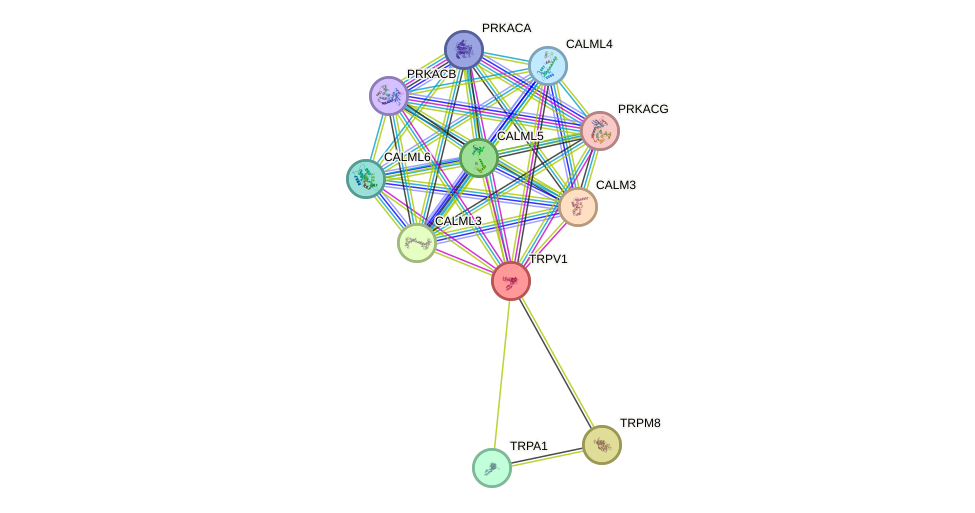
Retrieve sequences for TRPV1
Homologs in model organisms
- Caenorhabditis elegans
- ocr-2
- Caenorhabditis elegans
- ocr-3
- Caenorhabditis elegans
- ocr-1
- Caenorhabditis elegans
- ocr-4
- Caenorhabditis elegans
- osm-9
- Danio rerio
- trpv1
- Drosophila melanogaster
- nan
- Drosophila melanogaster
- iav
- Mus musculus
- Trpv1
- Rattus norvegicus
- Trpv1
In other databases
- GenAge model organism genes
Selected references
External links
- EPD
- ORF Accession
- NM_018727
- CDS Accession
- NP_061197
- OMIM
- 602076
- HPRD
- Ensembl
- TRPV1
- UniProt/Swiss-Prot
- TRPV1_HUMAN
- GeneCards
- TRPV1
- Entrez Gene
- 7442
- GenAtlas
- TRPV1
- Internet
- Search Google